Winter tyres in the Netherlands, Germany and Belgium: the rules explained
If you drive a company car to Germany or Belgium in winter, you may have to follow different winter tyre rules than in the Netherlands. Germany in particular requires extra attention: suitable tyres are mandatory as soon as road conditions become wintry. The Netherlands and Belgium do not have the same general requirement. In this article, we explain the rules in each country and what to check before setting off.
Winter tyre rules differ from country to country
If you regularly cross the border for work, you cannot rely solely on the Dutch rules. Traffic regulations differ between countries, and the same applies to winter tyres. A car that can legally be driven in the Netherlands may not meet the requirements in Germany when winter conditions occur.
It is not only a question of whether winter tyres are fitted. In Germany, the marking on the tyre is also important. If your car has all-season tyres, it is therefore worth checking which symbol appears on the tyre before travelling.
| Country | Are winter tyres mandatory? | Main rule |
|---|---|---|
| Netherlands | No | No general legal requirement for winter tyres |
| Germany | Yes, in winter conditions | Tyres must meet German winter requirements and carry the Alpine symbol |
| Belgium | No | No general legal requirement for winter tyres |
In short: winter tyres are not legally required in the Netherlands or Belgium. If you drive in Germany when road conditions are wintry, your car must be fitted with suitable winter or all-season tyres.
Winter tyres in the Netherlands: not mandatory
There is no legal requirement to use winter tyres in the Netherlands. This also applies when temperatures are low or snow has fallen. The Dutch government does recommend using tyres that suit the conditions in winter weather, as they can provide more grip on surfaces such as snow-covered roads.
There is therefore no fixed period during which winter tyres must be fitted. The familiar advice to switch to winter tyres around autumn is a practical recommendation rather than a legal deadline. For a business driver who only drives in the Netherlands, the choice of winter tyres mainly depends on how the car is used and the conditions in which it is driven.
Germany requires winter tyres in winter conditions
Germany takes a different approach. There is no fixed calendar period during which every car must have winter tyres. Instead, the requirement depends on the weather and road conditions. In snow, slush, black ice or slippery conditions caused by ice or frost, you may only drive if the car is fitted with tyres that meet the German requirements for winter conditions.
This means that a sunny drive through Germany in December does not automatically require winter tyres, while an unexpected spell of snow at another time of year may make them necessary. For business journeys to Germany, it therefore makes sense to check both the weather forecast and the tyres fitted to the car.
The Alpine symbol is important
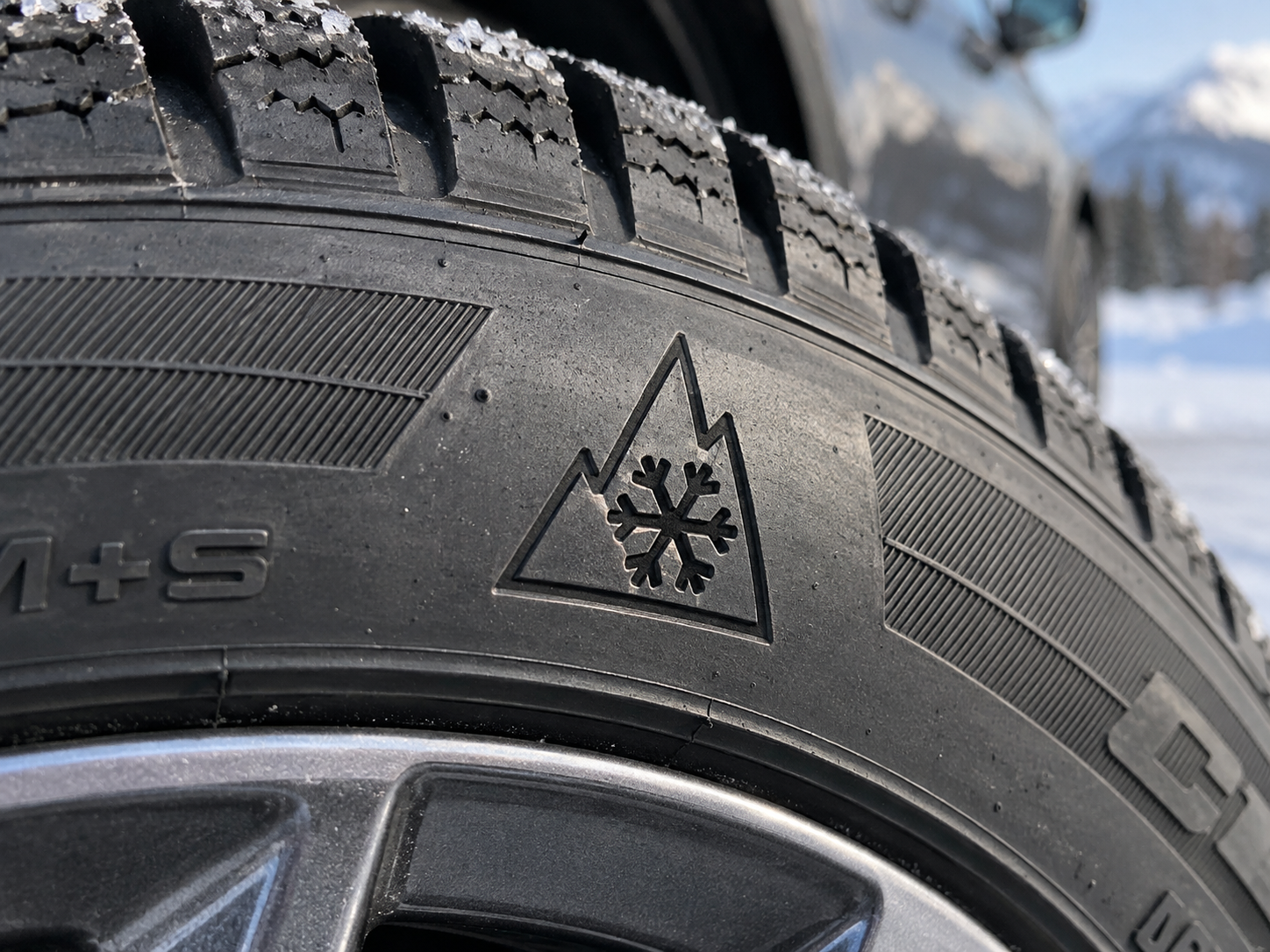
An important detail is the Alpine symbol, also known as the 3PMSF symbol. You can recognise it by a three-peaked mountain with a snowflake inside. Tyres used in Germany during winter conditions must carry this symbol.
An M+S marking on its own has no longer been sufficient since 1 October 2024. This is particularly relevant for older winter tyres and all-season tyres. If you only see M+S on the sidewall and no Alpine symbol, do not automatically assume that the tyre meets the German requirements for winter conditions.
Practical check: before a winter journey to Germany, look at the sidewall of the tyre. If you see a mountain symbol containing a snowflake, you have found the winter marking required under German rules.
Are all-season tyres allowed in Germany?
Yes, all-season tyres can be used in Germany during winter conditions, but only if they meet the legal requirements. The name of the tyre is therefore not decisive. The Alpine symbol shows whether the tyre is considered suitable for winter conditions.
With all-season tyres, do not simply check whether M+S appears on the sidewall. For use in winter conditions in Germany, the Alpine symbol must also be present. This can be particularly important with older tyres.
What about tyre tread depth in Germany?
The legal minimum tread depth for car tyres in Germany is 1.6 millimetres. However, this minimum does not tell you everything about how well a tyre performs in winter conditions. Wear affects how effectively the tread can clear snow, water and dirt.
It is therefore better not to wait until just before crossing the border to check whether the tyres still meet the legal minimum. Especially for cars that cover a lot of business mileage, it is sensible to keep an eye on both tyre wear and tyre pressure throughout the season.
Winter tyres in Belgium: no general requirement
Winter tyres are not generally mandatory in Belgium either. You can therefore drive on summer tyres during winter, provided the car and tyres meet the other legal requirements. Belgian police services do recommend winter tyres in winter conditions because of the additional grip they can provide.
For someone travelling from the Netherlands to a business appointment in Antwerp, Brussels or Ghent, crossing the border does not in itself create a winter tyre requirement. If you continue into Germany, however, the situation changes as soon as you encounter winter road conditions there.
The Netherlands, Germany and Belgium compared
| Netherlands | Germany | Belgium | |
|---|---|---|---|
| General winter tyre requirement | No | Depends on conditions | No |
| Fixed winter period defined by law | No | No | No |
| Mandatory in snow or icy conditions | No | Yes | No |
| Alpine symbol required in winter conditions | No | Yes | No |
Driving a Dutch shortlease car in Germany
If you drive a Dutch shortlease car in Germany, you must comply with the traffic rules that apply there. A Dutch registration plate does not change this. In winter conditions, check in advance which tyres are fitted to the car and whether they carry the Alpine symbol.
This is particularly important when several employees use the same car or when a company car is unexpectedly needed for a journey abroad. If you arrange shortlease for business, take international journeys into account when choosing the car and its equipment.
What about snow chains?
Winter tyres and snow chains are two different forms of winter equipment. In the Netherlands, snow chains generally cannot be used on public roads because they can damage the road surface. Permission may only be given in exceptional individual situations.
In Germany, a road sign may indicate that snow chains are compulsory. From that point onwards, you may only continue if the chains are fitted. When using snow chains in Germany, the maximum speed is 50 km/h. In Belgium, snow chains may be used when the road is covered with snow or ice.
Please note: if you are travelling to a winter sports or mountainous area, do not only check the rules for winter tyres. Additional requirements for snow chains may also apply along your route.
Check your car before a winter business trip
A journey abroad requires a little more preparation in winter than simply checking the route. If the car is normally used mainly in the Netherlands, it is worth checking beforehand whether the tyres are suitable for the country and conditions in which you will be driving.
- Check which countries you will be driving through and which winter rules apply.
- Check that the tyres have sufficient tread and are not damaged.
- For a journey to Germany, check whether the tyres carry the Alpine symbol.
- Check the tyre pressure before setting off on a longer journey.
- Check the weather forecast for the entire route, not just your destination.
- Check whether snow chains may be required if you are travelling to a winter sports or mountainous area.
Crossing the border for business with a suitable car
If you regularly drive to Germany or Belgium, it makes sense to consider international journeys when choosing a company car. The tyres, expected mileage and type of journeys all affect what is practical. This helps prevent you from having to find out at the last minute whether the car is suitable for a winter trip.
View the available shortlease cars or contact us if you would like to discuss which car suits your business use and international journeys.
Frequently asked questions about winter tyres in the Netherlands, Germany and Belgium
No, winter tyres are not mandatory in the Netherlands. There is also no fixed winter period during which you are legally required to use them. Suitable winter tyres may nevertheless provide additional grip in winter conditions.
In Germany, suitable winter tyres are mandatory when winter conditions occur, such as snow, slush, black ice or slippery roads caused by ice or frost. There is no fixed legal period during which every car must automatically have winter tyres.
Yes, all-season tyres are allowed in Germany during winter conditions if they meet the German requirements. Check whether the Alpine symbol, the mountain with a snowflake, appears on the tyre. An M+S marking on its own is no longer sufficient.
No, winter tyres are not generally mandatory in Belgium. You can therefore drive on summer tyres in winter, provided the car and tyres meet the other legal requirements. Suitable winter tyres may still be advisable in winter conditions.
No, an M+S marking on its own has no longer been sufficient for use in winter conditions in Germany since 1 October 2024. The tyre must carry the Alpine symbol to meet the German winter tyre requirements.
Yes, if you drive a Dutch car in Germany, German traffic rules apply during that journey. A Dutch company car or shortlease car must therefore also be fitted with tyres that meet the German requirements when winter conditions occur.